INDUSTRIAL STRATEGY & ENTREPRENEURSHIP
MACHINES 4 AFRICA LTD — Machinery and Factory Experts
Smart Capital on the Factory Floor: Why Slightly Used Machinery Beats Buying New
How can emerging entrepreneurs and growing manufacturers can preserve liquidity, accelerate commissioning, and build resilient production lines without paying the brand-new premium.
Industrial Insights • Machines 4 Africa Ltd • Manufacturing & Capital Allocation Series
Launching or expanding a manufacturing enterprise requires balancing ambition with financial discipline. For many first-time industrial founders across Africa, the instinct is to buy brand-new equipment straight from an original manufacturer's catalog. Yet across fast-growing industrial hubs from precision metalworking and plastics extrusion to agro-processing and automated packaging plants seasoned operators increasingly build their competitive edge around late-model, slightly used industrial machinery.
1. Escaping Steep First-Year Depreciation and Preserving Working Capital
Heavy industrial assets behave much like commercial vehicles the moment they leave the factory floor: they undergo sharp initial depreciation during their first two to three years of service, even when maintained under strict preventive schedules. By acquiring equipment that is two to five years old, an entrepreneur avoids absorbing that steepest drop in book value while gaining proven mechanical reliability.
More importantly, capital saved on the purchase price does not sit idle it becomes vital working capital. In African manufacturing, cash flow bottlenecks rarely stem from a lack of market demand; they arise from raw material deposits, specialized tooling, three-phase power upgrades, backup generators, quality testing, and payroll during early production runs. Retaining liquidity ensures a young factory can weather early operational friction rather than stalling under heavy debt service.
Furthermore, freeing up initial capital allows founders to invest in auxiliary systems that truly determine plant uptime such as voltage stabilizers, compressed air dryers, material handling equipment, and operator safety gear rather than exhausting their entire budget on a single flagship machine.
2. Immediate Availability and Faster Speed to Revenue
Ordering custom or brand-new industrial machinery often entails lengthy OEM manufacturing backlogs, ocean freight transit, port clearance, and factory commissioning queues that can stretch from six to fourteen months. During that waiting period, industrial warehouse rent, management salaries, and financing interest accumulate every month with zero production output to offset them.
Slightly used machines sourced through reputable industrial specialists like Machines 4 Africa Ltd are typically inspectable under power and ready for immediate dispatch. Cutting lead times from several quarters down to a few weeks allows new founders to fulfill customer purchase orders sooner, capture seasonal agricultural or construction demand cycles, validate product-market fit, and start generating positive cash flow early.
3. Faster Return on Investment (ROI) and Lower Break-Even Thresholds
For a new entrepreneur, the most dangerous phase of business is the gap between initial capital deployment and reaching operational break-even. When a factory carries an inflated capital expenditure load from brand-new machinery, fixed monthly depreciation and loan repayments force the business to operate at near-maximum capacity just to cover overhead.
Acquiring late-model pre-owned equipment at a fraction of the replacement cost dramatically lowers the factory's break-even volume. A plant running at 55% or 60% capacity during its first year of market entry can already achieve profitability, giving founders breathing room to refine product formulations, train operators, and build distribution networks without financial distress.
|
4. Proven Reliability and Straightforward Maintenance
Brand-new machinery frequently arrives with early-stage calibration quirks, sensitive sensors, and proprietary software locks that require specialized remote diagnostics or costly foreign OEM technician visits. By contrast, slightly used equipment from established global manufacturers has already passed its break-in phase and proven its durability in real-world duty cycles.
Furthermore, mature machine generations benefit from wide aftermarket spare-part availability, well-documented mechanical schematics, and local maintenance technicians who already understand their hydraulic, pneumatic, and PLC systems. For entrepreneurs operating in growing industrial ecosystems, practical serviceability on the shop floor is worth far more than untested digital interfaces.
5. Scaling Modularly Without Over-Committing Early
First-time industrial founders often overestimate initial order sizes or discover after six months of trading that customers prefer slightly different packaging formats, material thicknesses, or batch specifications. Locking up capital in an oversized, brand-new automated line leaves little flexibility to pivot.
With slightly used machinery, entrepreneurs can adopt a modular growth strategy: start with a reliable, right-sized production line today, prove unit economics with paying customers, and reinvest retained profits into a second parallel line once demand is verified. If market requirements shift, well maintained pre-owned industrial assets also retain strong resale value on the secondary market.
This phased approach is especially critical in dynamic regional markets where consumer packaging sizes, building codes, or industrial specifications evolve rapidly. Rather than betting the entire company on a single monolithic machine, modular lines allow plant managers to run parallel shifts, isolate maintenance downtime to one line without halting total factory output, and match energy consumption closely to daily order volumes.
6. High-Impact African Sectors Where Pre-Owned Machinery Excels
Across East, West, and Southern Africa, the economic advantages of slightly used industrial equipment play out across multiple high-growth manufacturing verticals. Understanding how each sector benefits help new entrepreneurs identify where pre-owned assets deliver the highest strategic leverage:
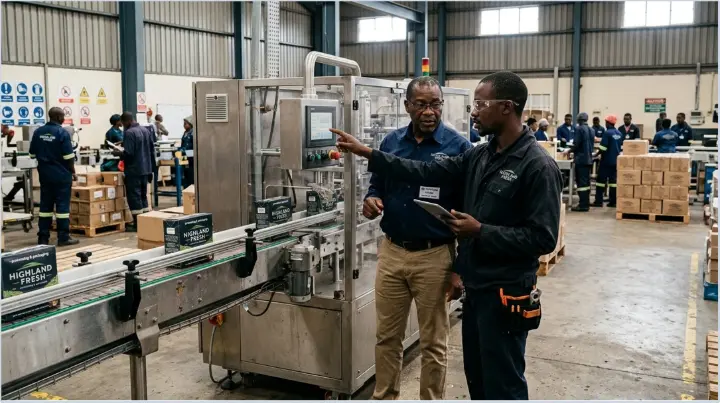
- Agro-Processing and Food Packaging: Grain milling, edible oil refining, dairy pasteurization, and automated form-fill-seal packaging lines built by European or Asian Tier-1 manufacturers are engineered for multi-decade lifespans. Acquiring a three-year-old stainless-steel bottling or pouch packing line enables local food processors to meet strict retail hygiene and shelf-life standards at a fraction of new plant costs.
- Plastics Extrusion, Blow Molding, and Recycling: Packaging films, HDPE containers, PVC piping, and post-consumer plastic pelletizing lines represent staple domestic demand across rapidly urbanizing African cities. Late-model extrusion and injection molding machines offer high screw-and-barrel precision while freeing up capital for resin inventory and chilled-water cooling towers.
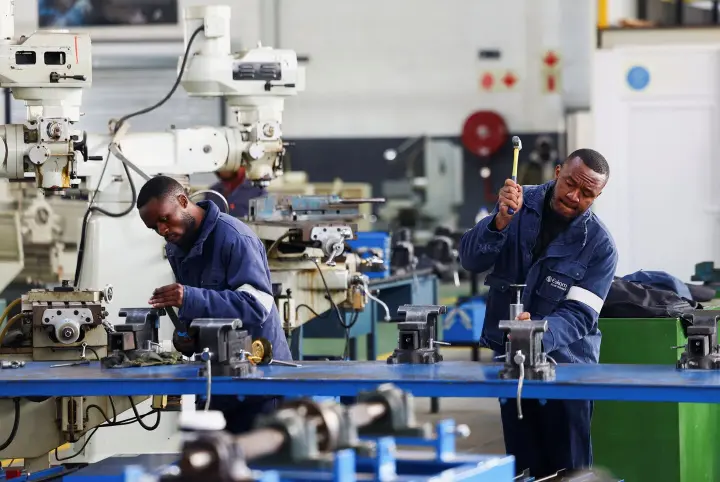
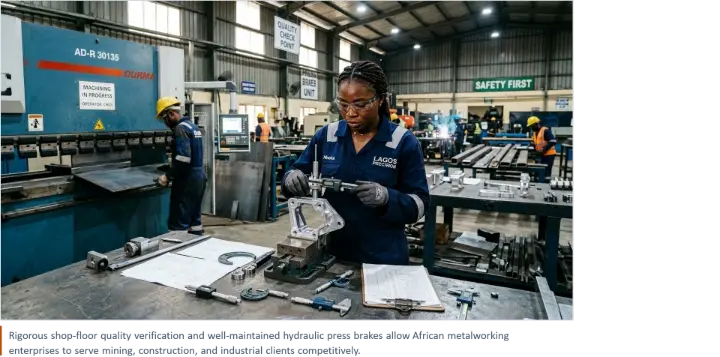
- Metal Fabrication and Precision Engineering: CNC machining centers, hydraulic press brakes, fiber laser cutters, and heavy-duty lathes retain structural rigidity for decades when properly lubricated. Local workshops serving construction, mining, and agricultural equipment repair can compete for lucrative industrial sub-contracts immediately by deploying vetted preowned machine tools.
- Construction Materials and Timber Processing: Concrete block-making plants, roofing sheet roll-formers, and industrial woodworking lines enable entrepreneurs to localize building material supply chains, cutting reliance on expensive imported finished goods while capturing strong margins in growing housing and infrastructure corridors.
7. Navigating Financing, Collateral, and Banking Realities
For emerging African entrepreneurs, commercial bank financing often carries high interest rates, strict collateral requirements, and short repayment tenors. Taking on a massive equipment loan to purchase brand-new machinery can strain debt-service coverage ratios before the factory even reaches steady-state production.
Lower upfront acquisition costs directly reduce the principal amount borrowed, lowering monthly debt obligations and preserving borrowing capacity for revolving working capital facilities. Additionally, development finance institutions, leasing companies, and commercial lenders increasingly view well-documented, late-model machinery from globally recognized OEMs as reliable hard collateral because its secondary market liquidation value is stable and verifiable unlike brand new equipment whose resale value drops sharply upon commissioning.
When presenting a business plan to investors or lenders, demonstrating capital efficiency through verified pre-owned equipment signals financial maturity. It shows stakeholders that the founding team prioritizes cash generation, unit-cost competitiveness, and risk mitigation over vanity showroom purchases.
Comparing Acquisition Paths for Growing Manufacturers
|
Evaluation Factor |
Brand-New Machinery |
Slightly Used (2–5 Years Old) |
|
Upfront Capital Outlay |
Full list price plus factory commissioning fees; high debt burden. |
Substantially lower acquisition cost; preserves cash for raw materials. |
|
Deployment Timeline |
Long factory builds slots and extended shipping lead times. |
Available for immediate inspection, shipping, and rapid installation. |
|
Depreciation Curve |
Steepest value drop occurs immediately after installation. |
Initial depreciation already absorbed by the previous owner. |
|
Parts & Technical Support |
Covered by short-term warranty, but proprietary parts can delay repairs. |
Established aftermarket parts supply and familiar local maintenance skills. |
|
Break-Even Capacity |
Requires high initial utilization to service heavy fixed capex. |
Achieves profitability at lower early production volumes. |
|
Resale & Exit Flexibility |
Steep early value loss if business model or capacity needs pivot. |
Retains strong secondary market value with minimal further depreciation. |
8. Practical Technical Due Diligence Before You Buy
Purchasing slightly used machinery rewards careful technical verification. While pre-owned equipment offers compelling financial advantages, skipping proper due diligence can expose a young enterprise to hidden refurbishment costs. Before committing funds, entrepreneurs should follow a disciplined six-point inspection and procurement checklist:
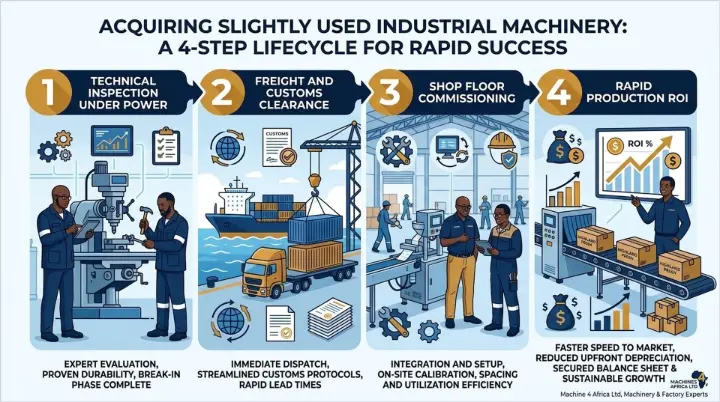
- Inspect Under Power: Always verify spindle runout, hydraulic pressure, pneumatic seals, heating elements, gearbox noise, and control panels during a live test run rather than relying solely on static photographs or marketing brochures.
- Audit Service Logs and Operating Hours: Request preventive maintenance records, PLC hour-meter readings, oil analysis reports, and major component replacement histories to distinguish lightly utilized machines from overworked units.
- Verify Spare Parts and Tooling Compatibility: Confirm that standard wear items such as bearings, belts, contactors, heating bands, sensors, PLC modules, and forming dies are readily obtainable locally or through regional distributors without proprietary lockouts.
- Assess Power, Frequency, and Utility Requirements: Verify three-phase voltage, electrical frequency (50Hz vs. 60Hz), compressed air volume, and cooling water specifications to ensure seamless integration with local industrial grid standards and avoid costly transformer retrofits.
- Confirm Complete Documentation and Software Access: Ensure the seller provides original electrical wiring diagrams, mechanical assembly drawings, operator manuals, and unlocked PLC/HMI passwords so local engineers can troubleshoot independently.
- Factor Total Landed Cost: Include professional rigging, container loading, ocean freight, marine insurance, port clearance, inland heavy transport, civil foundation preparation, and commissioning spares in your budget so there are no financial surprises at installation.
9. Planning Logistics, Customs, and Factory Floor Commissioning
A successful machinery acquisition extends beyond the purchase invoice it depends on seamless execution from the seller's floor to your production hall. New founders should map out critical prearrival milestones well before the container reaches port. Confirming import duty exemptions or industrial capital-goods incentives available under national manufacturing promotion schemes can save substantial sums at customs clearance.
Equally important is preparing the factory floor ahead of arrival. Reinforced concrete floor thickness, overhead crane or forklift rigging clearances, three-phase switchgear termination, and compressed air piping should be completed prior to delivery. When civil and electrical preparations are ready in advance, a vetted pre-owned machine can move from container unloading to trial production runs within days rather than months.
|
10. Partnering with Experienced Machinery Specialists
Navigating global industrial auctions, verifying seller credibility, coordinating international heavy freight, and conducting technical pre-shipment inspections can be daunting for a new factory owner working alone. One overlooked mechanical fault or missing control module can erase initial purchase savings.
Partnering with an established technical intermediary such as Machines 4 Africa Ltd bridges the gap between global surplus equipment markets and local African factory floors. By working with seasoned machinery and factory experts who understand local power grids, spare-part ecosystems, and industry-specific throughput demands, entrepreneurs ensure their equipment is rigorously vetted, matched to exact production targets, and supported through installation and commissioning.
Bottom Line for New Founders: Customers judge your factory by the consistency, quality, and timely delivery of your finished goods not by the manufacturing year stamped on your equipment's nameplate. Acquiring slightly used, well-maintained industrial machinery lets entrepreneurs enter the market faster, protect their balance sheets, and scale capacity sustainably as orders grow.